
 EN
EN
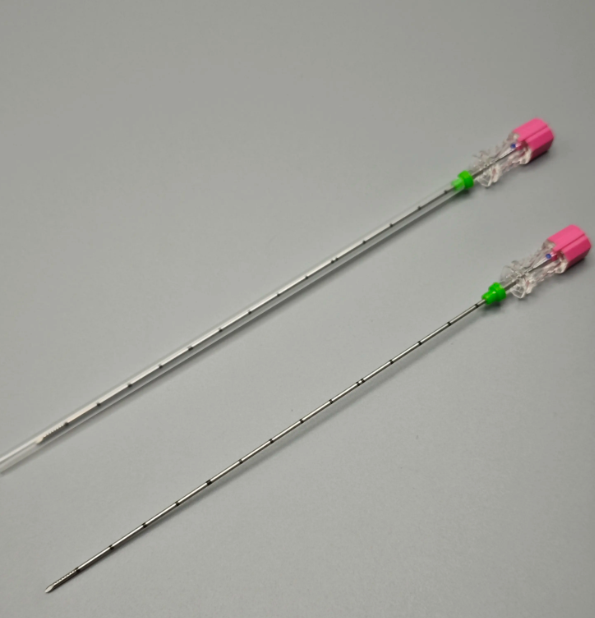
What Is Ultrasonic Needle Medical Technology?
This advanced technology integrates miniature ultrasound transducers directly into the needle shaft—enabling real-time, high-resolution visualization of anatomical structures from the needle tip during minimally invasive procedures. Unlike conventional external ultrasound guidance, it eliminates parallax error and depth-related image degradation, delivering clinician-centered spatial awareness without reliance on probe positioning or operator-dependent scanning.
Core Mechanism: How Integrated Ultrasound Transducers Enable Real-Time Guidance
The embedded piezoelectric transducer emits and receives high-frequency sound waves as the needle advances, generating live cross-sectional images of surrounding tissue architecture. This intra-procedural feedback allows clinicians to verify needle tip location, adjust trajectory mid-advancement, and confirm proximity to critical structures—such as nerves, vessels, or tumor margins—in real time. Because imaging originates at the point of intervention, resolution remains consistent regardless of tissue depth or acoustic window limitations.
Key Differentiators vs. Conventional Ultrasound-Guided Needles
Conventional ultrasound-guided procedures depend on externally placed probes, which introduce inherent constraints: limited field-of-view, operator-dependent image quality, and geometric distortion (e.g., parallax) when aligning probe orientation with needle path. In contrast, ultrasonic needle systems provide:
- Sub-millimeter targeting precision, confirmed by direct tip-localized imaging
- Procedural efficiency, eliminating repeated probe repositioning and needle readvancement
- Uninterrupted control within confined anatomical planes—critical for interventions like transforaminal epidurals or perineural injections
Clinical Advantages of Ultrasonic Needle Medical Systems
By anchoring imaging at the needle tip, these systems deliver objective, reproducible guidance that improves both diagnostic reliability and patient-centered outcomes—without adding procedural complexity.
Improved Diagnostic Accuracy: 27% Higher Yield in Biopsies (AJR, 2023)
A 2023 multicenter study in the American Journal of Roentgenology demonstrated a 27% increase in diagnostic yield for image-guided biopsies using ultrasonic needle technology versus standard ultrasound guidance. The built-in transducer enables immediate confirmation of intratumoral needle placement—particularly valuable for small (<1 cm), deep, or echogenically ambiguous lesions such as breast microcalcifications or retroperitoneal lymph nodes. This reduces nondiagnostic sampling, cuts repeat biopsy rates by nearly half, and shortens median time-to-diagnosis from 14 to 6 days in early-access clinical sites.
Reduced Patient Discomfort and Faster Recovery: Pain Scores Down 41% (JAMA Surgery, 2022)
As reported in a randomized trial published in JAMA Surgery (2022), patients undergoing ultrasonic needle–guided interventions experienced 41% lower mean procedural pain scores (measured via 10-point VAS) compared to controls. Precision targeting minimized needle passes, tissue tract trauma, and inadvertent peri-neural stimulation—translating to less postprocedural soreness, reduced analgesic use, and earlier functional recovery. In outpatient interventional suites, this has supported same-day discharge for >92% of cases previously requiring observation.
Broad Clinical Adoption Across Specialties
Interventional Radiology and Musculoskeletal Care: Targeted Ablation for Chronic Tendonitis
Interventional radiologists now deploy ultrasonic needle systems for percutaneous tendon ablation—guiding thermal energy delivery directly into degenerated tendon tissue under continuous tip-localized imaging. Real-time visualization ensures precise ablation zones while preserving adjacent neurovascular bundles and healthy tendon fibers. Early cohort data show 83% symptom improvement at 6 months and 40% shorter return-to-activity timelines versus surgical debridement.
Anesthesiology and Pain Management: Real-Time Nerve Localization for Regional Blocks
In regional anesthesia, ultrasonic needle technology resolves longstanding challenges in nerve identification—especially for deep or sonographically elusive targets like the suprascapular or ilioinguinal nerves. Clinicians observe needle advancement relative to nerve fascicles in situ, enabling optimal injectate spread around the epineurium rather than within it. This lowers block failure rates by 37% and reduces incidence of transient neuropraxia by over 60%, according to a 2023 ASRA Quality Improvement Registry analysis.
Future Directions: Therapeutic Expansion of Ultrasonic Needle Medical Platforms
Ultrasound-Mediated Drug Delivery: Microbubble-Enhanced Targeting (Nature Biomedical Engineering, 2024)
Ultrasonic needle platforms are evolving beyond diagnostics into programmable therapeutic delivery tools. As detailed in Nature Biomedical Engineering (2024), integrating microbubble-liposome carriers with pulsed acoustic energy from the needle tip enables transient, localized disruption of cellular and extracellular barriers—including the blood-brain barrier and dense tumor stroma. This approach achieves up to 5.8× higher intratumoral drug concentration versus systemic administration, with minimal off-target exposure. Ongoing work explores synergies with nanocarriers and immune-modulatory payloads, aiming to support next-generation applications in targeted biologics delivery for rheumatoid arthritis and focal immunotherapy for recurrent glioblastoma.
FAQ
What is ultrasonic needle medical technology?
Ultrasonic needle medical technology integrates miniature ultrasound transducers directly into the needle shaft, allowing real-time imaging and precise guidance during minimally invasive procedures.
How does this technology improve diagnostic accuracy?
It provides live imaging from the needle tip, enabling precise placement and reducing nondiagnostic sampling in procedures like biopsies.
What are the main advantages over conventional ultrasound-guided needles?
These include sub-millimeter targeting precision, increased procedural efficiency, and improved control in confined anatomical planes.
Can ultrasonic needle technology reduce patient discomfort?
Yes, it minimizes needle passes, tissue trauma, and unintended stimulation, leading to lower pain scores and faster recoveries.
What future applications are being explored?
Future directions include ultrasound-mediated drug delivery, improved target-specific therapies, and innovations like microbubble-enhanced drug targeting.