
 EN
EN
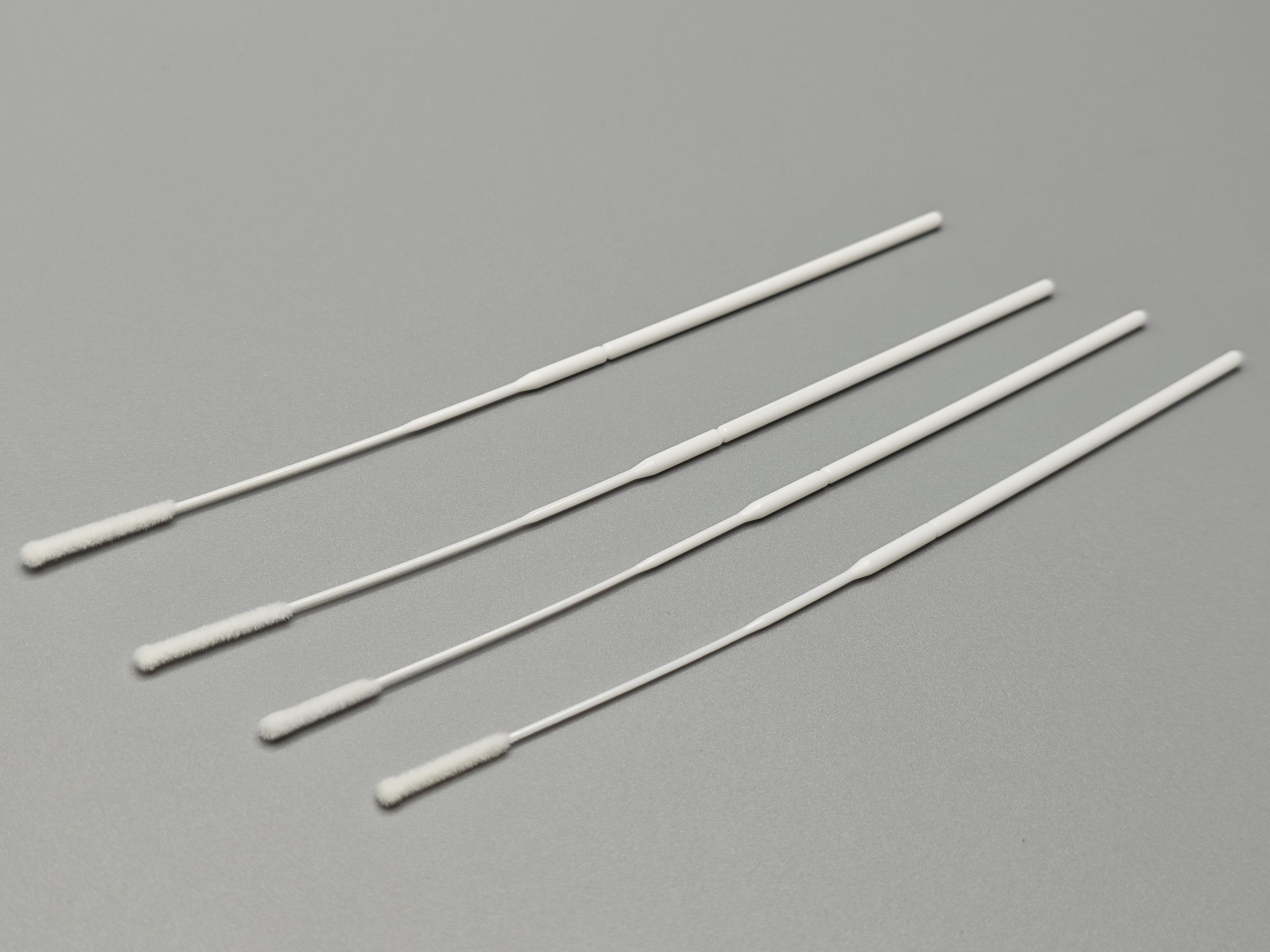
How Swab Material and Design Directly Impact Microbial Recovery
Flocked vs. Conventional Swabs: Quantifying Bacterial Capture Efficiency
The physical architecture of a swab tip fundamentally determines microbial collection and release efficiency. Conventional wound-fiber swabs—typically cotton or rayon—rely on a dense, twisted fiber matrix that traps microbes internally, limiting both capture and elution. In contrast, flocked swabs feature perpendicularly aligned fibers that create an open capillary network, dramatically increasing surface area and enabling efficient lift-and-release of microorganisms. A foundational study demonstrated that flocked swabs achieve ~60% microbial recovery, compared to just ~20% for traditional rayon swabs (Dalmaso et al., 2008). This gap stems not only from superior initial capture but, critically, from near-complete elution into transport media—where conventional swabs retain significant bioburden within their fiber bundles. Subsequent research confirms that tip material and structural design remain primary determinants of sampling accuracy (Jansson et al., 2020). Selecting flocked over conventional swabs can therefore more than double viable microbial counts, directly strengthening contamination control decisions.
Hydrophilic Coating and Release Performance in Nylon Flocked Swabs
Even among flocked swabs, surface chemistry governs release performance. Standard nylon flocked tips, while mechanically effective, are inherently hydrophobic—causing microbial adhesion and incomplete elution. A hydrophilic coating modifies surface tension to promote rapid, thorough wetting and expulsion of collected material during immersion. Comparative testing shows hydrophilic-treated flocked swabs deliver 69% total bacterial recovery, versus 53% for untreated nylon flocked swabs under identical conditions (independent comparative analysis, 2015). The coating enhances capillary action both during sampling—drawing liquid and organisms into the tip—and during elution—actively expelling them into diluent. This minimizes residual hold-up, a critical advantage in pharmaceutical cleaning validation and sensitive environmental monitoring, where undetected bioburden can falsely suggest cleanliness. By integrating flocked architecture with hydrophilic surface engineering, modern swabs approach recovery rates that support detection of low-level contamination with analytical confidence.
Standardizing Swab Technique to Minimize Operator-Induced Variability
Pressure, Rotation, and Dwell Time: Evidence-Based Protocols for Consistent Surface Sampling
Operator technique is the largest uncontrolled variable in surface microbiology. Standardizing three mechanical parameters—contact pressure, rotation, and dwell time—significantly reduces inter-operator variability and improves data reliability. Research identifies 25–30 g/cm² as the optimal pressure range for stainless steel surfaces: sufficient to dislodge microbes without damaging cells or embedding them in swab fibers (Pharmaceutical Technology, 2022). Rotation must be continuous and full (360°), ensuring all fibers engage the surface uniformly. When paired with a controlled dwell time of 10–15 seconds over a standardized 25 cm² area, these parameters improve recovery by up to 40% versus unstructured wiping (Journal of Applied Microbiology, 2021). Effective protocols specify a slow, overlapping zigzag motion with steady rotation—not rapid, superficial passes. Embedding these parameters into written standard operating procedures reduces inter-operator variability to under 15%, enabling meaningful trend analysis in environmental monitoring programs. Training should emphasize tactile feedback—teaching operators to recognize proper pressure and rhythm—as these fundamentals anchor reproducible bioburden data.
Swabs in Action: Industry-Specific Applications and Validation Requirements
Food Safety Environmental Monitoring: Swabs for Conveyor Belts, Slicers, and High-Risk Zones
In food processing, swabs serve as frontline tools for verifying sanitation in pathogen-prone zones. Conveyor belts, slicers, and adjacent high-risk areas accumulate moisture and organic residue—ideal conditions for biofilm formation. Swabbing these surfaces post-cleaning provides direct, quantitative evidence of residual contamination, validating hygiene protocols. For dry, flat surfaces like high-speed conveyors, pre-moistened swabs optimize microbial pickup without equipment damage. In complex geometries—slicer blades, drive chains, drains—robust swabs disrupt thin biofilms, releasing bacteria into the collection medium for accurate enumeration. A strategic, consistent swabbing plan—defined sites, frequency, and methodology—transforms raw data into predictive trend analysis, enabling proactive contamination prevention.
A well-designed environmental monitoring swab must include:
- A durable, flexible shaft capable of accessing awkward angles without breaking;
- A tip material engineered for high-efficiency cell release, minimizing entrapment and false-negative risk;
- Sterile, single-use packaging to eliminate extraneous contamination.
Pharmaceutical Cleaning Validation: Why Swabs Remain the Gold Standard for Bioburden Assessment
Swabbing remains the regulatory gold standard for cleaning validation in pharmaceutical manufacturing, explicitly endorsed by the FDA’s 1993 Guide to Inspections as the “most desirable” method for assessing microbial and chemical residue removal. Its superiority lies in direct physical contact: unlike rinse sampling—which captures only soluble residues—swabs dislodge and collect adhered contaminants from actual product-contact surfaces, including the intricate geometries of tablet presses, filling needles, and mixer blades. The process involves wiping a precisely defined area with a wetted swab, extracting the residue, and analyzing it at parts-per-trillion sensitivity levels. This direct evidence confirms cleaning efficacy and cross-contamination control—core requirements of Good Manufacturing Practice (GMP).
Reliability hinges entirely on swab quality. Poorly constructed swabs may shed fibers, leach adhesives, or fail structurally—introducing interferents that compromise assay integrity. Validated swabs for this application must demonstrate exceptionally low extractables and high particle-freeness. As shown in the comparative table below, swabbing excels where residue adherence and surface complexity demand physical removal:
| Sampling Method | Primary Advantage | Critical Limitation | Best Application |
|---|---|---|---|
| Swab Sampling | Direct, physical removal of residue from surfaces | Requires accessible surfaces and can be technique-dependent | Equipment with complex shapes, low-solubility residues, and hard-to-clean areas |
| Rinse Sampling | Covers large, inaccessible internal surfaces | Only captures soluble residues; may not detect strongly adhered contaminants | Tanks, pipes, and large enclosed systems |
With recovery rates routinely exceeding 70% for targeted residues, a well-executed swab protocol delivers the sensitivity and specificity required to safeguard patient safety—reinforcing its irreplaceable role in robust cleaning validation.
Preventing Cross-Contamination: Swab Innovations for Complex and Hard-to-Reach Surfaces
Ergonomic Design Advances — Angled Shafts, Ultra-Thin Tips, and Sterile Single-Use Packaging
Cross-contamination poses acute risks in pharmaceutical cleanrooms and food processing facilities—where studies link up to 30% of hospital-acquired infections to contaminated devices (Journal of Hospital Infection, 2023). Modern swab design directly mitigates this through purpose-built ergonomics. Angled shafts enable precise access to corners, seams, and recessed hardware without compromising sterility or requiring awkward positioning. Ultra-thin, precision-molded tips maintain consistent contact across irregular surfaces—maximizing recovery while reducing the risk of residue transfer. Critically, sterile, individually sealed packaging eliminates reuse entirely, ensuring each swab is deployed in a contamination-free state. These integrated features transform swabs from simple collection tools into calibrated sampling instruments—supporting compliance with stringent validation protocols and enabling proactive management of cross-contamination risk.
FAQ
What is the primary benefit of flocked swabs over conventional swabs?
Flocked swabs feature perpendicularly aligned fibers that allow for higher microbial recovery rates of around 60%, compared to just 20% for conventional swabs. They also provide near-complete elution into transport media.
How does a hydrophilic coating improve swab performance?
A hydrophilic coating modifies surface tension, promoting thorough wetting and expulsion of collected material, which enhances recovery rates and minimizes residual hold-up.
What are the optimal swabbing techniques to minimize variability?
Optimal techniques involve maintaining 25–30 g/cm² of pressure, continuous 360° rotation, and a dwell time of 10–15 seconds over a standardized area for consistent microbial recovery.
Why are swabs considered the gold standard for cleaning validation in pharmaceutical environments?
Swabs provide direct evidence of cleaning efficacy by physically removing adhered contaminants from surfaces, ensuring sensitive and specific detection of microbial or chemical residues.
How do swab design innovations prevent cross-contamination?
Modern swabs feature angled shafts, ultra-thin tips, and sterile single-use packaging, which help access complex surfaces accurately while reducing cross-contamination risks.
Table of Contents
- How Swab Material and Design Directly Impact Microbial Recovery
- Standardizing Swab Technique to Minimize Operator-Induced Variability
- Swabs in Action: Industry-Specific Applications and Validation Requirements
- Preventing Cross-Contamination: Swab Innovations for Complex and Hard-to-Reach Surfaces
-
FAQ
- What is the primary benefit of flocked swabs over conventional swabs?
- How does a hydrophilic coating improve swab performance?
- What are the optimal swabbing techniques to minimize variability?
- Why are swabs considered the gold standard for cleaning validation in pharmaceutical environments?
- How do swab design innovations prevent cross-contamination?