
 EN
Anatomical and Virological Rationale for Nasopharyngeal Swab Superiority
High viral load concentration in the nasopharynx during early infection
The nasopharynx serves as the primary replication site for many respiratory viruses, including SARS‑CoV‑2, influenza, and RSV. During the initial 3–5 days of infection, viral shedding peaks here—driven by the high density of ciliated epithelial cells and abundant ACE‑2 receptors—making it the richest source of pathogen nucleic acid before systemic dissemination. A 2023 meta‑analysis found that nasopharyngeal swabs yielded median viral loads 2 log₁₀ higher than anterior nasal or oropharyngeal specimens (Ct value differences of 6–8 cycles), translating to detection sensitivity gains of 15–20 percentage points in early disease. This consistent yield of 10³–10⁶ genome copies per milliliter supports reliable amplification even in high-throughput, pooled testing protocols.
Proximity to respiratory epithelium and Waldeyer’s ring lymphoid tissue enables optimal pathogen capture
The nasopharynx lies directly beneath the skull base and envelops Waldeyer’s ring—a network of lymphoid tissues including the adenoids and tubal tonsils. This anatomical arrangement forms a sentinel immune interface where inhaled pathogens first encounter mucosa‑associated lymphoid tissue. Influenza A and Neisseria meningitidis, for example, preferentially adhere to the non‑ciliated epithelium of the nasopharyngeal vault before deeper invasion. By inserting the swab to ≥6 cm, clinicians sample this epithelial–lymphoid nexus, capturing both free virions and intracellular pathogens. Research shows that rotating the swab and holding it for 15 seconds retrieves a dense mixture of respiratory epithelium and immune cells—providing a comprehensive snapshot of host–pathogen interaction. This dual collection explains why nasopharyngeal sampling outperforms throat-only methods for detecting bacterial meningitis carriers and early influenza, even in mild cases.
Clinical Evidence: Diagnostic Accuracy Across Major Respiratory Pathogens
Sensitivity comparison: 92.4% for SARS-CoV-2 vs. 75.8% for anterior nasal swabs (NEJM, 2022)
A pivotal 2022 New England Journal of Medicine study directly compared specimen types: nasopharyngeal swabs achieved 92.4% sensitivity for SARS-CoV-2, while anterior nasal swabs attained only 75.8%. This 16.6-percentage-point difference reflects the higher viral load concentrated in the nasopharynx during early acute infection—when prompt and accurate detection is essential for clinical management and infection control. The swab’s deeper reach targets the respiratory epithelium where active viral replication occurs, markedly lowering the false-negative rate associated with shallower collection methods. As a result, national testing protocols and hospital-based laboratories widely designate nasopharyngeal sampling as the gold-standard reference for molecular diagnostic assays in symptomatic individuals and high-risk exposure scenarios.
Consistent high-yield detection for influenza A/B, RSV, and bacterial meningitis pathogens
Beyond SARS-CoV-2, nasopharyngeal swabs deliver consistently high diagnostic yields for influenza A/B, RSV, and key bacterial meningitis pathogens. In influenza outbreaks, nasopharyngeal sampling exceeds 90% sensitivity—outperforming throat or mid-turbinate swabs. For RSV—particularly in pediatric populations—it remains the specimen of choice per CDC and AAP clinical guidelines. For Neisseria meningitidis and Haemophilus influenzae, early colonization occurs in the posterior nasopharynx; thus, NP swabbing is essential for accurate carriage detection. This broad performance stems from direct access to mucosal surfaces and Waldeyer’s ring lymphoid tissue—the primary sites of pathogen replication and immune engagement. Consequently, multiplex molecular panels are validated primarily against nasopharyngeal swab references, ensuring cross-assay comparability and clinical confidence.
Practical Implementation: Standardized Nasopharyngeal Swab Collection Technique
Achieving the high diagnostic accuracy of a nasopharyngeal swab depends on meticulous adherence to a standardized collection protocol. Even minor deviations can compromise specimen quality—so every step must be performed with precision and consistency.
Critical procedural steps: depth (≥6 cm), rotation, 10–15 sec dwell time, and appropriate transport media
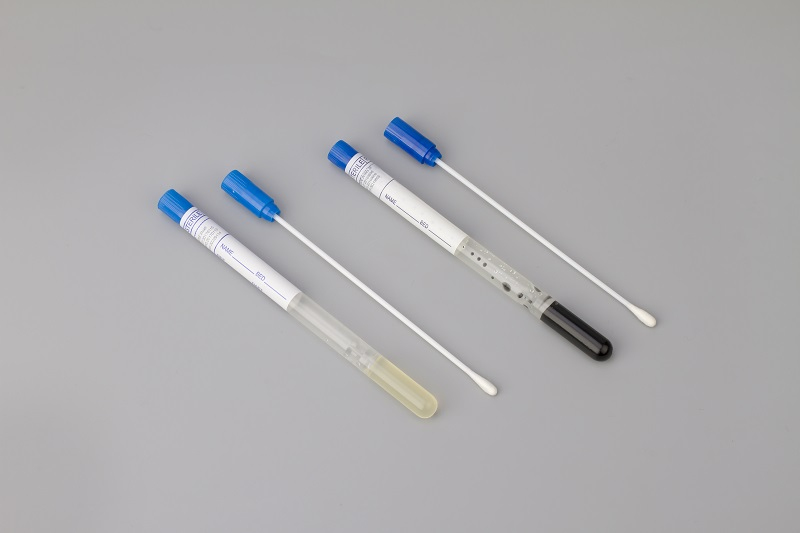
Proper collection begins with patient positioning: the head is tilted back ~70 degrees to align the nasal passage. Using a flexible, mini-tip synthetic fiber swab (never wood or calcium alginate, which inhibit PCR), the clinician inserts it gently along the floor of the nasal cavity—parallel to the palate—until reaching at least 6 cm or encountering resistance at the posterior nasopharynx. Once positioned, the swab is rotated 3–5 times to collect epithelial cells, then held in place for 10–15 seconds to absorb secretions. Immediately after withdrawal, the tip is snapped into viral transport medium (VTM) or universal transport medium (UTM), which preserves nucleic acids and suppresses bacterial overgrowth. Specimens must be refrigerated and shipped within 72 hours; prolonged room-temperature storage degrades labile RNA viruses and reduces recovery.
Mitigating operator-dependent variability through training and checklist adoption
Variability in technique is a leading cause of false-negative results—but structured training significantly improves specimen adequacy. Modules using anatomical models and video demonstrations help clinicians internalize correct angle, depth, and dwell time. Pairing initial training with periodic competency assessments reinforces retention. A simple, evidence-informed collection checklist—covering head tilt, swab type, insertion depth, rotation count, dwell time, and immediate immersion in transport media—reduces omission errors. In multi-center audits, institutions implementing such checklists saw rates of fully adequate specimens rise from 68% to over 90% within six months. Simulation-based just-in-time coaching further narrows performance gaps between experienced and novice operators—ensuring every swab meets the same high standard.
Limitations and Contextual Considerations for Nasopharyngeal Swab Use
Despite its superior sensitivity, the nasopharyngeal (NP) swab presents notable practical limitations. Insertion to ≥6 cm is inherently uncomfortable and may provoke gagging, sneezing, or minor epistaxis—necessitating trained healthcare professionals and precluding safe self-administration. Consequently, NP swabs are poorly suited for mass community testing programs, where throughput, participant comfort, and logistical simplicity are priorities. Compared with anterior nasal swabs—which achieve 75.8% sensitivity for SARS-CoV-2 but allow self-collection—the NP swab’s 92.4% sensitivity comes with greater procedural complexity, staffing demands, and aerosol generation risk. In drive-through sites, schools, or low-resource settings, these constraints often limit adoption. Therefore, while NP swabs remain the reference standard for diagnostic accuracy, their use must be contextualized by available personnel, patient tolerance, and operational feasibility.
| Aspect | Nasopharyngeal Swab | Anterior Nasal Swab |
|---|---|---|
| Comfort | Invasive, can cause pain, gagging, bleeding | Minimally uncomfortable |
| Skill Required | Trained healthcare professional | Self-administered or minimal training |
| Sampling Depth | ≥6 cm into nasopharynx | 1–2 cm into anterior nares |
| Suitability for Mass Screening | Poor due to need for trained staff and discomfort | Excellent for high-throughput self-swabbing |
| Diagnostic Sensitivity (SARS-CoV-2) | 92.4% (NEJM, 2022) | 75.8% (NEJM, 2022) |
FAQ Section
What is the primary replication site for respiratory viruses during early infection?
The nasopharynx serves as the primary replication site during the initial stages of infection, driven by the high density of ciliated epithelial cells and abundant ACE-2 receptors.
Why is nasopharyngeal swab considered superior to anterior nasal swab?
Nasopharyngeal swabs achieve higher diagnostic sensitivity due to their ability to sample dense viral loads concentrated in the nasopharynx during early infection.
Is the nasopharyngeal swab suitable for mass testing programs?
No, due to its invasive nature and requirement for trained healthcare professionals, it is unsuitable for large-scale, community testing programs.
What are the critical procedural steps for collecting a nasopharyngeal swab?
Key steps include tilting the head back, inserting the swab ≥6 cm, rotating several times, holding for 10–15 seconds, and immersing the tip immediately in viral transport media.
What challenges are associated with nasopharyngeal swab collection?
Challenges include discomfort, gagging, bleeding, and procedural variability that require structured training and periodic assessments to mitigate.
Table of Contents
- Anatomical and Virological Rationale for Nasopharyngeal Swab Superiority
- Clinical Evidence: Diagnostic Accuracy Across Major Respiratory Pathogens
- Practical Implementation: Standardized Nasopharyngeal Swab Collection Technique
- Limitations and Contextual Considerations for Nasopharyngeal Swab Use
-
FAQ Section
- What is the primary replication site for respiratory viruses during early infection?
- Why is nasopharyngeal swab considered superior to anterior nasal swab?
- Is the nasopharyngeal swab suitable for mass testing programs?
- What are the critical procedural steps for collecting a nasopharyngeal swab?
- What challenges are associated with nasopharyngeal swab collection?