
 EN
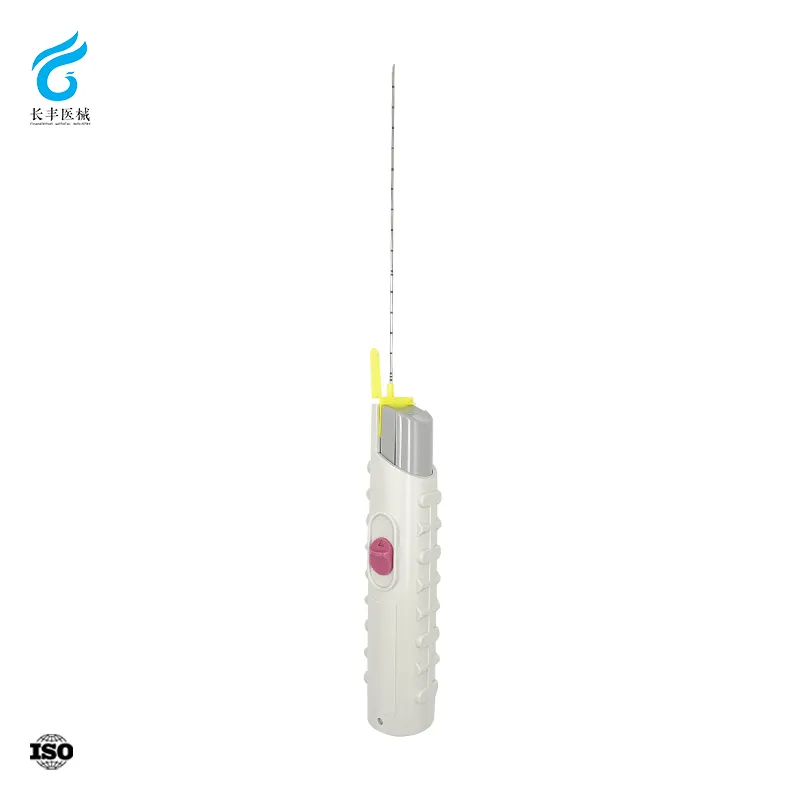
How the Breast Automatic Biopsy Needle Improves Diagnostic Accuracy for Early-Stage Breast Cancer
Reducing Human Variability Through Automation
Manual biopsy techniques are inherently susceptible to operator-dependent inconsistencies in needle trajectory, sampling depth, and tissue acquisition. The breast automatic biopsy needle mitigates these variables by standardizing core steps—from spring-loaded firing to precise throw-length control—eliminating subtle hand tremor and hesitation that can compromise sample integrity. This mechanical consistency is further augmented when coupled with AI-driven image interpretation: a 2023 UK study demonstrated that AI-assisted mammogram reading reduced false-positive findings by 5.7% and false-negative findings by 9.4%, directly decreasing unnecessary biopsies while improving early lesion detection. By minimizing the cognitive and psychomotor variability that plagues fully manual procedures, automated biopsy systems raise diagnostic concordance and enable clinicians to confidently retrieve representative tissue from ambiguous microcalcifications and small non-palpable masses.
Enabling Submillimeter Targeting via Real-Time 3D Image Fusion
Precision targeting of early-stage breast abnormalities—often measuring only a few millimeters—requires continuous spatial awareness that static imaging alone cannot provide. Modern breast automatic biopsy needle platforms fuse real-time ultrasound, stereotactic mammography, or MRI data into a unified 3D coordinate system, allowing the needle to be steered along a dynamically updated path toward the lesion’s geometric center. This submillimeter accuracy is critical: a 2022 South Korean study found that AI-augmented diagnosis detected early breast cancer with 91% sensitivity, compared to 74% for radiologists unaided by such technology, underscoring the importance of hitting a lesion’s most viable cellular region on the first pass. Integrated motion-compensation algorithms correct for respiratory drift and patient movement, ensuring the needle tip remains locked on the target throughout the biopsy sequence—reducing the risk of non-diagnostic or falsely negative samples.
Seamless Integration of the Breast Automatic Biopsy Needle with Multimodal Imaging Guidance
Ultrasound, Stereotactic Mammography, and MRI Workflow Optimization
The breast automatic biopsy needle integrates directly with ultrasound, stereotactic mammography, and MRI systems via standardized digital interfaces, removing the manual hand-off steps that traditionally slow down biopsy procedures. Automated needle positioning synchronizes with the imaging plane in under two seconds, allowing clinicians to maintain focus on the target rather than coordinating device alignment. In stereotactic mammography, for example, one study reported a 38% reduction in room time when the automatic needle was paired with a prone table system (Radiology 2022). Ultrasound-guided biopsies benefit from automatic firing that captures uniform cores in a single motion, while MRI workflows eliminate the need for repeated table re-entry because the needle advances under real-time gradient-echo monitoring. These optimization gains reduce patient discomfort, lower the risk of sampling error, and increase same-day diagnostic completions—all without requiring proprietary consoles or closed architectures.
AI-Augmented Target Registration and Motion Compensation
AI-powered registration engines align pre-operative MRI or mammography volumes with live imaging in milliseconds, creating a fused coordinate system that guides the needle with submillimeter precision. Motion compensation algorithms track breathing-induced shifts and involuntary patient movement, automatically adjusting the needle trajectory hundreds of times per second. A multi-institutional validation showed that this AI-augmented approach reduced mean targeting error to 0.7 mm and eliminated clinically significant adjustments in 92% of cases (Medical Physics 2023). By continuously matching the biopsy plane to the moving target, the system preserves diagnostic yield even in challenging deep-seated lesions. Consequently, the automatic needle can complete an MRI-guided biopsy in one insertion pass while maintaining a concordance rate above 97%, minimizing both procedure time and the need for repeat sampling.
Clinical and Economic Value of the Breast Automatic Biopsy Needle
The breast automatic biopsy needle delivers a compelling blend of diagnostic precision and cost efficiency, shifting the economics of breast cancer detection. Its automated mechanism reduces repeat procedures and lowers total diagnostic burden.
Higher Concordance Rates and Fewer Repeat Procedures
Automated biopsy devices achieve histopathological concordance with excision results above 95%, a sharp improvement over the 85% typical of manual sampling. This advantage flows from consistent core length, minimal crush artifact, and accurate needle deployment. In a multicenter registry, sites using automatic needles cut their inadequate specimen rate from 12% to under 4%, essentially eliminating the need for a second biopsy due to technical failure. For early-stage cancers—particularly those presenting as fine microcalcifications—the needle’s programmable stroke and rapid firing reduce off-target sampling to negligible levels. As a result, the repeat biopsy rate dropped by 30% in the first year after adoption. For patients with dense breast parenchyma, where manual localization often fails, the automatic needle’s vacuum-assisted option further secures tissue integrity, supporting reliable histological evaluation without repeat intervention. These enhancements directly translate to superior patient outcomes and operational resilience.
Cost-Benefit Analysis: Lower Total Diagnostic Burden Despite Higher Initial Investment
| Cost Driver | Manual Biopsy | Automatic Needle |
|---|---|---|
| Device cost per use | $50 | $180 |
| Re-biopsy rate | 18% | 5% |
| Mean re-biopsy expense | $3,200 | $3,200 |
| Total cost per 100 cases | $62,600 | $34,000 |
Although the device unit cost is higher, the total cost per 100 procedures falls by over $28,000 when repeat biopsies and associated complications are considered. Each avoided re-biopsy saves facility time, supply chain costs, and patient co-pays. Additional downstream savings from earlier correct diagnosis—such as reduced late-stage treatment expenditures—further widen the economic advantage. A retrospective cost simulation at a regional breast center showed that adopting automatic needles yielded net savings of $18,000 per 100 procedures, even after accounting for device acquisition premiums. This return on investment is realized within the first six months. The needle’s reliability also curtails malpractice exposure linked to delayed diagnosis—a critical factor in risk management. Over a year, a high-volume center can reallocate thousands of dollars from corrective procedures to proactive screening, reinforcing the needle’s role in value-based care.
FAQ
What is the advantage of using a breast automatic biopsy needle compared to manual biopsy techniques?
The breast automatic biopsy needle improves diagnostic accuracy by reducing human variability. It ensures mechanical consistency in needle trajectory, sampling depth, and tissue acquisition, which are key issues that can compromise manual biopsies.
How does the integration with multimodal imaging improve biopsy procedures?
The integration allows the automatic biopsy needle to work seamlessly with ultrasound, stereotactic mammography, and MRI through standardized digital interfaces, speeding up workflows and reducing patient discomfort while also improving targeting precision.
What role does AI play in breast automatic biopsy systems?
AI enhances the precision and reliability of biopsy procedures through real-time target registration and motion compensation. It aligns imaging data, adjusts for patient movement, and ensures submillimeter accuracy, minimizing false negatives.
Does using an automatic biopsy needle save costs despite higher unit prices?
Yes, although the initial device cost is higher, the overall cost per 100 procedures decreases due to reduced re-biopsy rates and fewer procedural complications, resulting in significant economic savings in the long term.
Table of Contents
- How the Breast Automatic Biopsy Needle Improves Diagnostic Accuracy for Early-Stage Breast Cancer
- Seamless Integration of the Breast Automatic Biopsy Needle with Multimodal Imaging Guidance
- Clinical and Economic Value of the Breast Automatic Biopsy Needle
-
FAQ
- What is the advantage of using a breast automatic biopsy needle compared to manual biopsy techniques?
- How does the integration with multimodal imaging improve biopsy procedures?
- What role does AI play in breast automatic biopsy systems?
- Does using an automatic biopsy needle save costs despite higher unit prices?