
 EN
EN
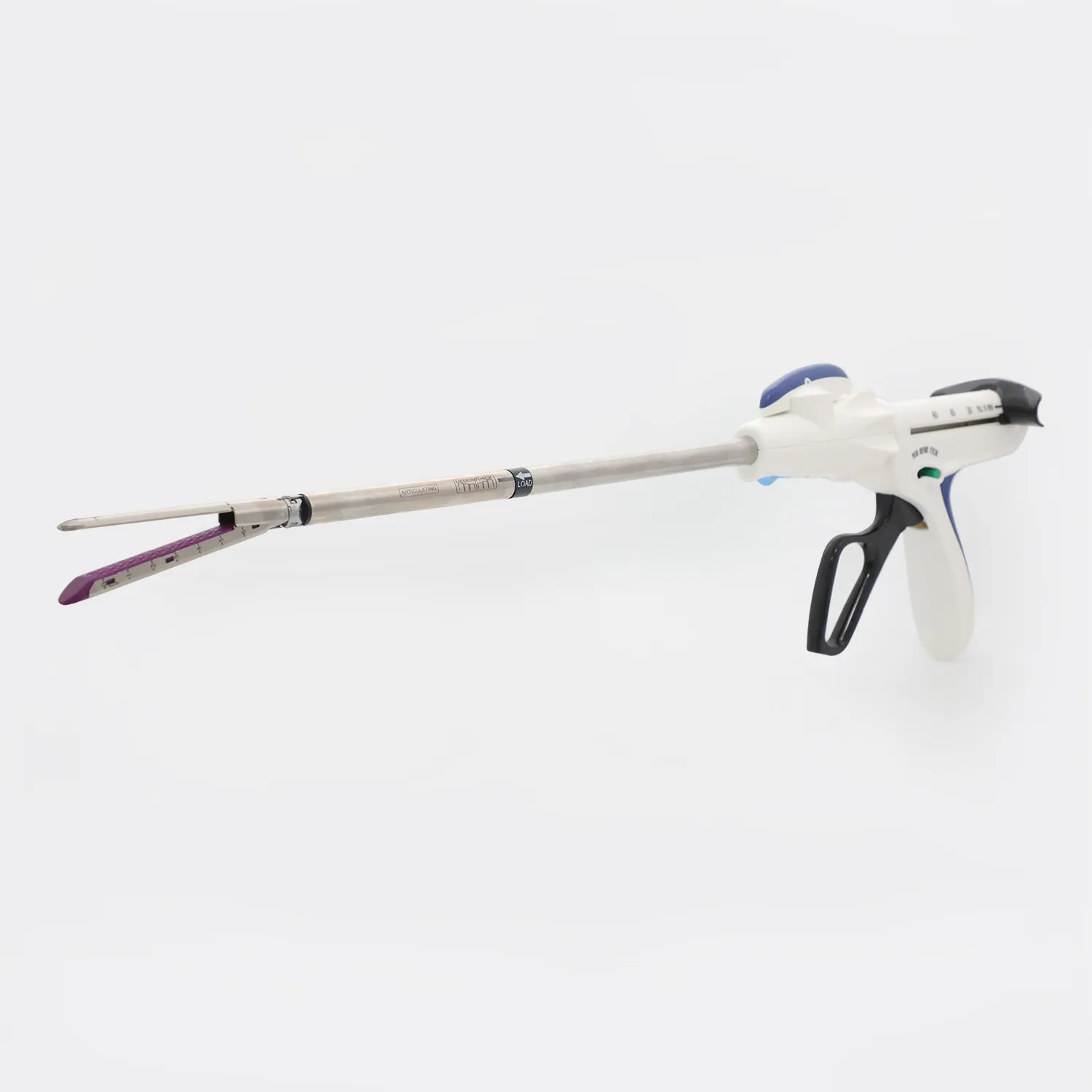
How the Disposable Endo Linear Cutter Stapler Works: Dual-Action Mechanics and Tissue Response
Sequential biomechanics: tissue compression, staple formation, and linear transection
The disposable endo linear cutter stapler executes a precisely timed, three-phase sequence that transforms manual closure into a reliable anastomosis. Initial jaw closure applies controlled, uniform compression across the tissue—reducing thickness and displacing interstitial fluid to stabilize the target site and minimize bleeding. Once optimal closed height is achieved, the firing mechanism simultaneously drives two staggered rows of B-shaped titanium staples on each side of the intended cut line. The inner staple legs deform against the anvil, locking into a secure, self-cinching configuration that maintains hemostasis even under postoperative tension. Immediately after staple formation, an integrated, single-use blade travels distally between the two staple rows, transecting the tissue in a clean linear cut. The resulting staple line leaves a narrow, double-row margin on both proximal and distal segments, providing immediate wound sealing.
This integrated action eliminates separate cutting and suturing steps, reduces instrument exchanges, and shortens the critical phase of tissue handling. By compressing, stapling, and cutting in a single, uninterrupted motion, the device limits tissue trauma, preserves microvascular perfusion at the staple line, and minimizes intraoperative contamination risk. The entire sequence is performed through a 12-mm or 15-mm trocar—ideal for laparoscopic and thoracoscopic procedures where precision and speed are paramount. Consistent biomechanical output depends on precise alignment of the cartridge, anvil, and knife channel, as well as steady surgeon-applied closure pressure—all ensured by the device’s single-use design to prevent performance degradation from reuse.
Impact of compression time and tissue thickness on staple line integrity and leak risk
Compression time and tissue thickness critically influence staple line integrity. Tissue too thick for the selected staple cartridge—or compressed too briefly—fails to form complete staple closure. Under-compression leaves staple legs partially open, increasing the risk of persistent bleeding or anastomotic leakage. Conversely, excessive compression time or using a cartridge with insufficient staple height can crush microvessels, causing localized ischemia and subsequent necrosis—elevating the risk of delayed dehiscence.
Surgical guidelines recommend a pre-compression phase of 15–30 seconds before firing to allow tissue stabilization and fluid redistribution, improving staple formation consistency. Staple height selection—typically 2.5 mm, 3.5 mm, or 4.8 mm—must be matched to measured tissue thickness after compression. Many modern cartridges incorporate color-coded indicators to support this decision. Careful attention to these parameters, combined with the device’s sharp, single-use blade, directly contributes to lower leak rates. Even minor deviations can compromise integrity, underscoring the importance of surgeon judgment and the device’s built-in biomechanical safeguards.
Gastrointestinal Surgery: Evidence-Based Use in Resection and Anastomosis
Laparoscopic colectomy and gastrectomy: technique optimization and complication mitigation
The disposable endo linear cutter stapler has become a cornerstone of minimally invasive colorectal and gastric resections, enabling simultaneous tissue transection and anastomosis through a single firing. Technique optimization centers on matching reload color to tissue thickness—white for thin duodenum, blue for standard colon/stomach, and green for thick pylorus—and maintaining controlled compression for 3–5 seconds before firing to allow tissue fluid egress and uniform staple formation. A survey of 241 Japanese gastroenterological surgeons found that 31% of staple-line complications were attributable to incorrect reload selection or insufficient compression, highlighting the need for strict adherence to these parameters.
Additional mitigation strategies include avoiding excessive tension on anastomotic limbs, confirming patent hemostasis after firing, and using buttressing material when the serosa is friable. When consistently applied, these practices help the disposable endo linear cutter stapler achieve a leak rate of under 3% in laparoscopic colectomy and gastrectomy—translating into fewer reoperations and shorter hospital stays.
Comparative outcomes: disposable endo linear cutter stapler versus hand-sewn anastomoses in RCTs
Direct randomized comparisons between the disposable endo linear cutter stapler and hand-sewn techniques remain sparse, but meta-analyses of large-scale observational data provide meaningful insight. In a meta-analysis of gastric bypass procedures, linear-stapled gastrojejunal anastomoses produced a leak rate of 2.1%, falling within the 2–5% range commonly reported for hand-sewn colorectal anastomoses. Although differences are not statistically significant in most cohorts, the stapler consistently reduces anastomotic construction time by 10–15 minutes—a practical advantage in prolonged laparoscopic cases.
Notably, mechanical stapling yields less variance in staple line integrity across surgeons of differing experience levels, whereas hand-sewn outcomes are more operator-dependent. When combined with strict adherence to reload selection and compression protocols, the disposable endo linear cutter stapler offers a safe, reproducible alternative to sutured anastomoses, with a complication profile that matches or improves upon historical hand-sewn benchmarks.
Thoracic and Bariatric Applications: Specialized Techniques and Safety Protocols
VATS lobectomy and wedge resection: parenchymal sealing efficacy of the disposable endo linear cutter stapler
In VATS (Video-Assisted Thoracoscopic Surgery) lobectomy, the disposable endo linear cutter stapler delivers simultaneous cutting and stapling with precise tissue compression. Staple line integrity depends on proper tissue thickness assessment and adequate compression time. A 2022 multicenter study demonstrated a 30% reduction in air leak incidence compared to older stapling devices—attributed to improved staple formation and even tissue approximation. The integrated cutting mechanism transects lung parenchyma cleanly, minimizing tearing at the staple line. Surgeons select reloads with varying staple heights to match tissue thickness, ensuring optimal closure. For wedge resections, the device’s articulation allows access to deep chest anatomy, enabling secure sealing of peripheral lesions. The ability to fire multiple reloads quickly without exchanging instruments reduces operative time. Modern versions also offer tactile feedback to confirm complete closure before firing, further reducing technical failures. Overall, staple line pneumostasis remains below 8% in most series.
Sleeve gastrectomy standardization: staple line placement, reinforcement strategies, and leak prevention
Sleeve gastrectomy standardization requires exact staple line placement along the lesser curvature to avoid leaks and strictures. The disposable endo linear cutter stapler creates a narrow gastric tube with consistent geometry. Consistent staple height selection—e.g., 3.5 mm for thicker tissue, 2.5 mm for thinner—is critical. Reinforcement strategies reduce the risk of staple line bleeding and leak. A 2023 meta-analysis of 12,000 patients found that buttressing the staple line with absorbable synthetic or biological materials reduced leak rates from 1.5% to 0.5%. Surgeons must ensure no tissue overlap at the staple line, and the device’s articulating tip facilitates angled firing to maintain equidistance from the endoscope. Postoperative leak prevention also hinges on avoiding thermal injury during stapling and confirming hemostasis. Many protocols now incorporate routine intraoperative leak testing with methylene blue. These measures, combined with meticulous staple line inspection, have driven down major complication rates in high-volume centers.
| Staple Line Reinforcement | Leak Rate | Bleeding Events | Average Operative Time Increase |
|---|---|---|---|
| None | 1.5% | 2.8% | — |
| Synthetic buttress | 0.5% | 1.2% | 4 minutes |
| Biological (e.g., pericardium) | 0.6% | 1.0% | 6 minutes |
FAQs
What is the role of compression time in staple formation?
Compression time is critical for tissue stabilization and fluid redistribution before firing. A pre-compression phase of 15–30 seconds is recommended to achieve consistent staple formation and minimize leak risk.
How do variations in tissue thickness affect surgical outcomes?
Incorrect staple height selection or inadequate compression can compromise staple line integrity, leading to bleeding or leaks. Matching the cartridge to the measured tissue thickness after compression is essential.
What are the main advantages of disposable endo linear cutter staplers in laparoscopic procedures?
These staplers allow simultaneous cutting and stapling, reduce operative time, and minimize tissue trauma compared to separate suturing steps. They deliver reliable biomechanical output and maintain hemostasis even under tension.
How does staple line reinforcement reduce complications?
Reinforcement materials like synthetic or biological buttresses decrease leak rates and bleeding events. Studies show reinforcement can reduce leak rates from 1.5% to 0.5%, though it may slightly increase operative time.